Address
JINKE Technology Industrial Park, No. 3188 ChunYuan Road, Weifang City, Shandong Province, China
Work Hours
Monday to Friday: 7AM - 7PM
Weekend: 10AM - 5PM
Address
JINKE Technology Industrial Park, No. 3188 ChunYuan Road, Weifang City, Shandong Province, China
Work Hours
Monday to Friday: 7AM - 7PM
Weekend: 10AM - 5PM

Small-batch orders look safer, but the wrong factory can still drain cash, delay launches, and trap your brand in endless revisions.
To evaluate a clothing manufacturer for small-batch orders in 2026, check category fit, MOQ flexibility, sample discipline, communication speed, quality control, lead-time realism, and willingness to support lower-volume growth.
Many suppliers say they support small-batch production, but only a few can do it smoothly without sacrificing quality, delivery control, or communication clarity. The real test is not what they promise, but how they operate when your order size is still modest.
A factory can advertise a low MOQ and still be the wrong partner if its whole system is built for large-volume efficiency.
Small-batch experience matters more than low MOQ claims because factories that truly support smaller orders can manage flexibility, communication, and production planning without treating your project as a low-priority distraction.
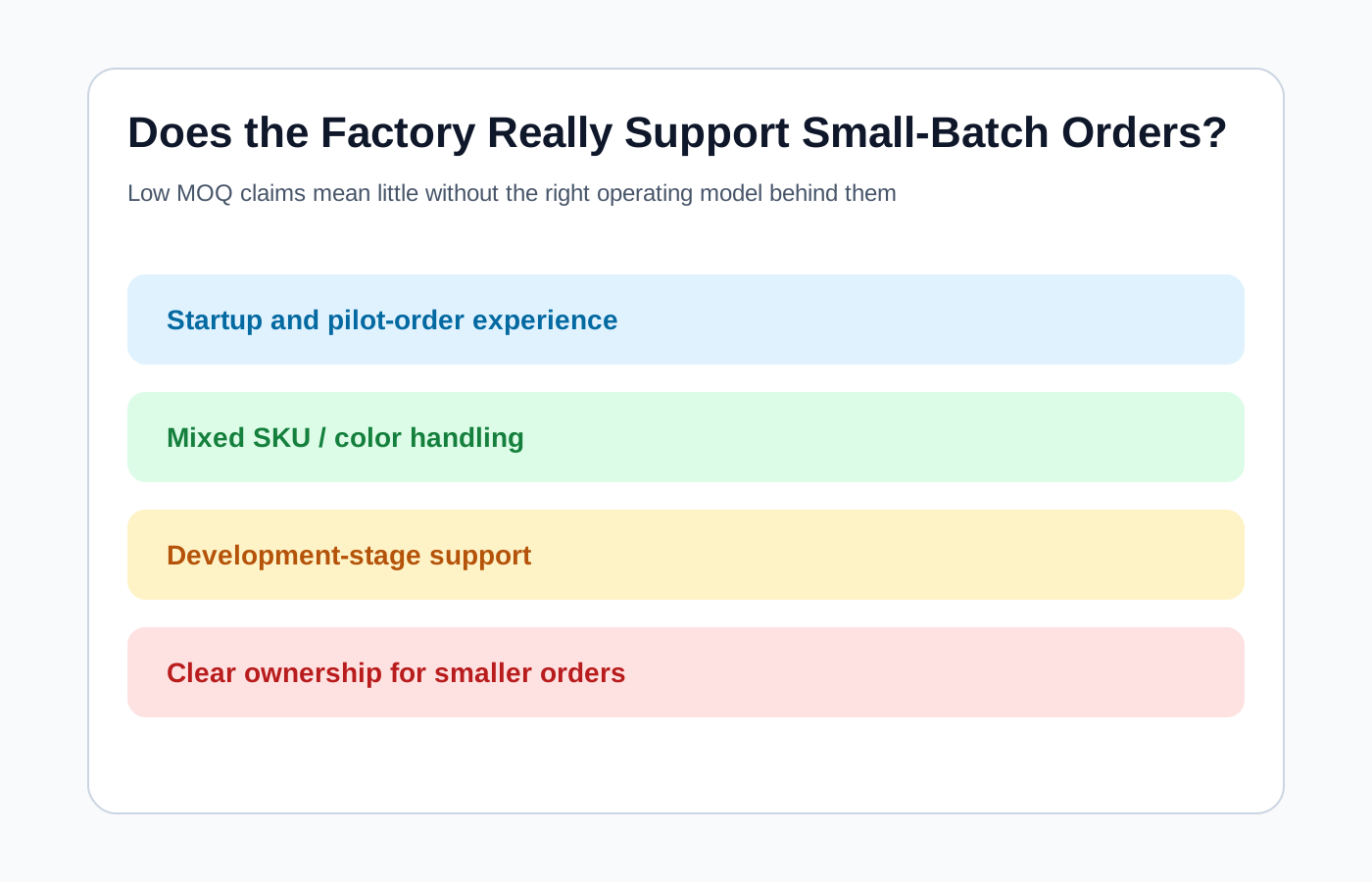
Many buyers get attracted by a supplier that says, “Our MOQ is low,” but that answer alone means very little. A factory may technically accept a small order while still deprioritizing it, quoting unstable timelines, or pushing buyers into unsuitable material or trim compromises. Small-batch-friendly manufacturers usually show different behavior: they explain how they handle development orders, mixed color runs, pilot production, and future scaling. They also understand that smaller brands often need more support in sampling, decision-making, and quality alignment before moving into larger production volumes.
Buyers should ask whether the supplier has worked with startups, independent brands, test-market launches, or limited seasonal capsules. That matters because small-batch production is not only about order quantity. It is about operational mindset.
| Checkpoint | Why it matters | What to ask |
|---|---|---|
| Startup or pilot-order experience | Shows flexibility in smaller runs | “Have you supported emerging brands or trial launches before?” |
| Mixed style / color handling | Tests operational adaptability | “Can you manage multiple SKUs in one small order?” |
| Development-stage support | Helps when specs are still evolving | “How do you work with brands still refining details?” |
| Scaling logic | Indicates future partnership potential | “How does pricing or planning change if volume grows later?” |
| Order prioritization | Reveals whether small clients get ignored | “Who manages smaller orders internally?” |
A supplier that genuinely understands small-batch work is often more valuable than one with a low headline MOQ but weak execution discipline.
When order size is limited, a weak sample process can wipe out profit before bulk production even begins.
Buyers should assess sample quality by checking fit accuracy, workmanship consistency, revision speed, material matching, and how clearly the supplier handles comments and technical updates.
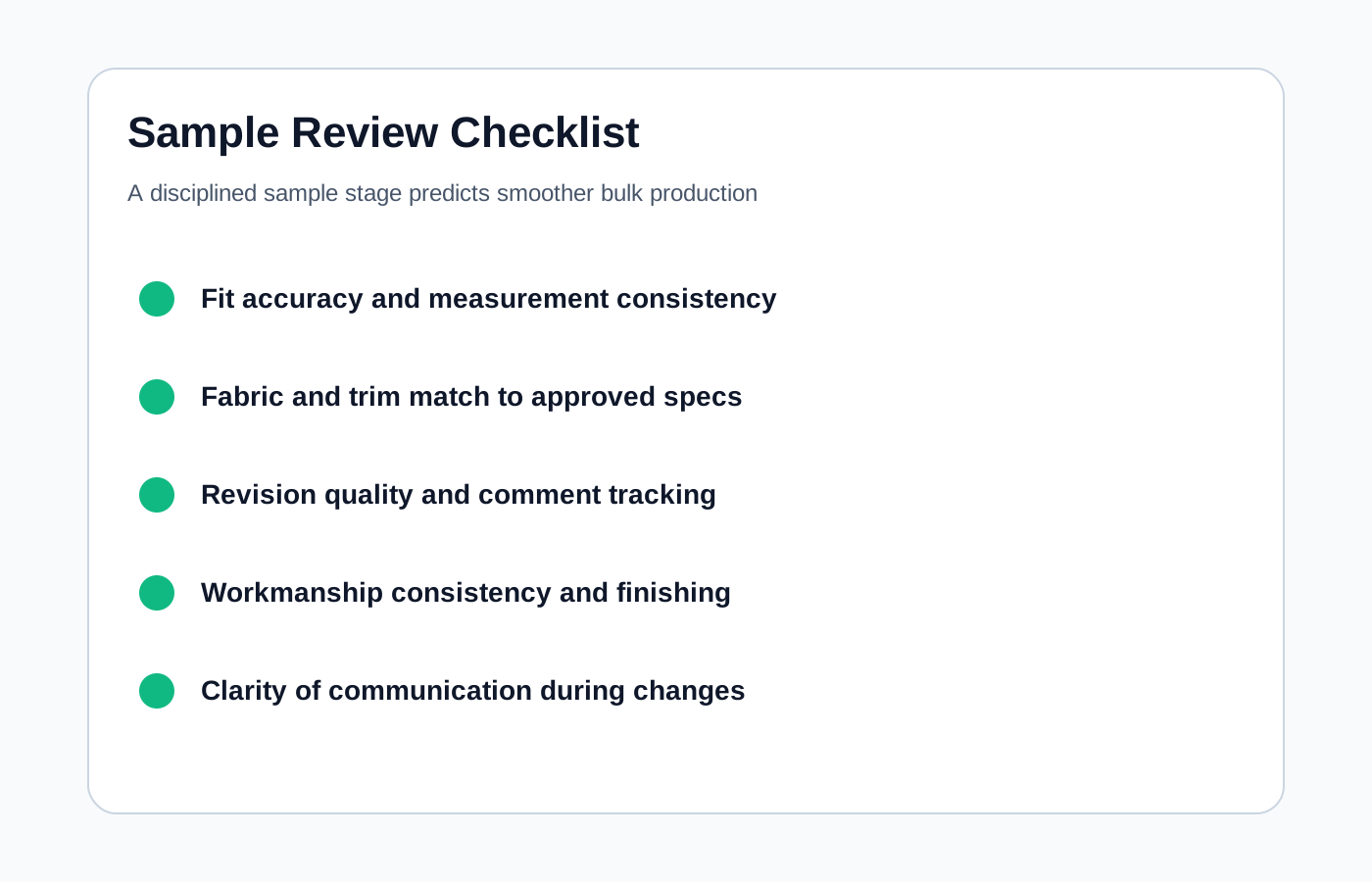
For small-batch orders, the sample stage carries even more weight because there is less volume to absorb mistakes. If the first sample shows inconsistent stitching, weak finishing, poor fabric substitution, or repeated misunderstanding of basic comments, the supplier may struggle even more in bulk. Buyers should look beyond whether the sample “looks okay” and focus on whether the factory can follow instructions precisely, explain trade-offs honestly, and improve efficiently between rounds.
A reliable sample process should include clear lead times, documented comments, visible ownership, and structured revisions. If a supplier sends a revised sample without addressing your actual notes, that is not just a sample issue. It is a preview of how future production problems may be handled.
| Sample factor | Strong signal | Weak signal |
|---|---|---|
| Fit execution | Pattern reflects requested silhouette and measurements | Fit changes are random or unexplained |
| Material accuracy | Fabrics and trims stay close to approved specs | Materials are swapped casually |
| Revision quality | Comments are addressed one by one | Changes are partial or ignored |
| Workmanship consistency | Stitching and finishing are stable | Quality varies across the same sample |
| Communication during revision | Supplier explains what changed and why | Supplier sends updates with no clarity |
For smaller orders, a disciplined sample stage is one of the clearest indicators that a factory can protect both quality and timeline under tighter commercial constraints.
Factories rarely fail because they speak too little in the sales stage; they fail because communication collapses when details become operational.
Reliable communication means fast replies, clear ownership, direct answers to technical questions, and proactive updates when timing, materials, or risks change.
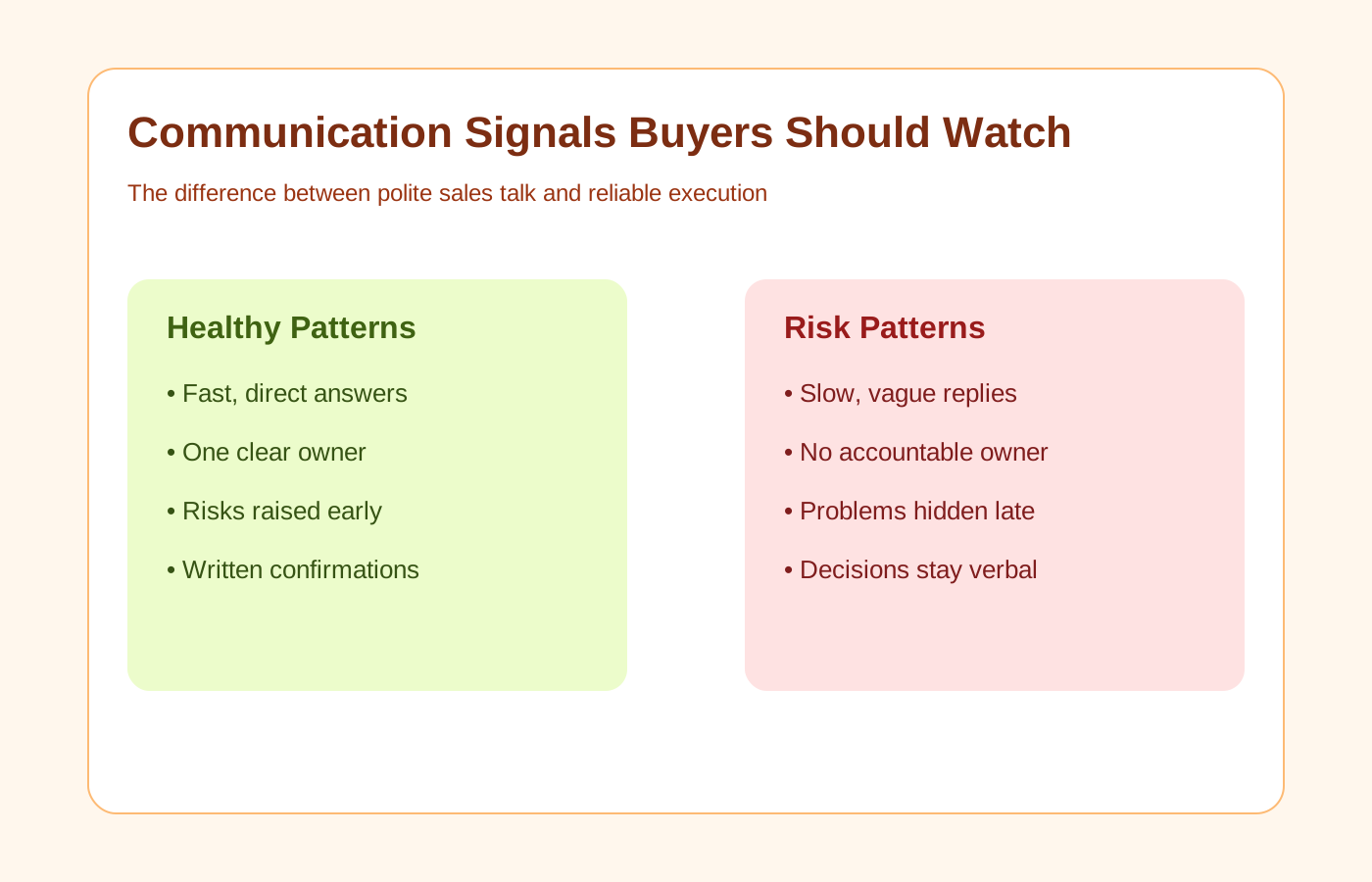
Many factories sound responsive when discussing quotes, but the real communication test starts once sampling, approvals, and production details enter the conversation. Buyers should watch how the supplier answers technical questions, whether different team members stay aligned, and whether issues are raised early or only after delays appear. Good communication is not just friendliness. It is operational transparency.
For small-batch buyers, communication quality matters even more because smaller brands often need faster clarification cycles and tighter decision loops. If a supplier is vague, slow, or inconsistent, problems compound quickly. Reliable factories usually provide clear points of contact, explain lead-time risks honestly, and confirm decisions in writing instead of relying on assumptions.
| Signal | Healthy pattern | Risk pattern |
|---|---|---|
| Response speed | Timely, specific replies | Slow or repetitive answers |
| Technical clarity | Direct explanation of process and constraints | Generic sales language |
| Ownership | One accountable coordinator or clear chain | Too many voices, no owner |
| Risk reporting | Problems flagged early | Issues hidden until late |
| Written confirmation | Changes documented clearly | Decisions remain verbal and fuzzy |
Communication quality shapes quality control, sample success, and delivery reliability. It is one of the strongest predictors of whether a small-batch partnership will stay manageable.
Even a modest order can damage your brand if defects reach customers, especially when every unit matters financially.
The most important quality-control checks for small-batch production are material verification, inline inspection, measurement control, finishing review, packing checks, and clear handling of defects before shipment.
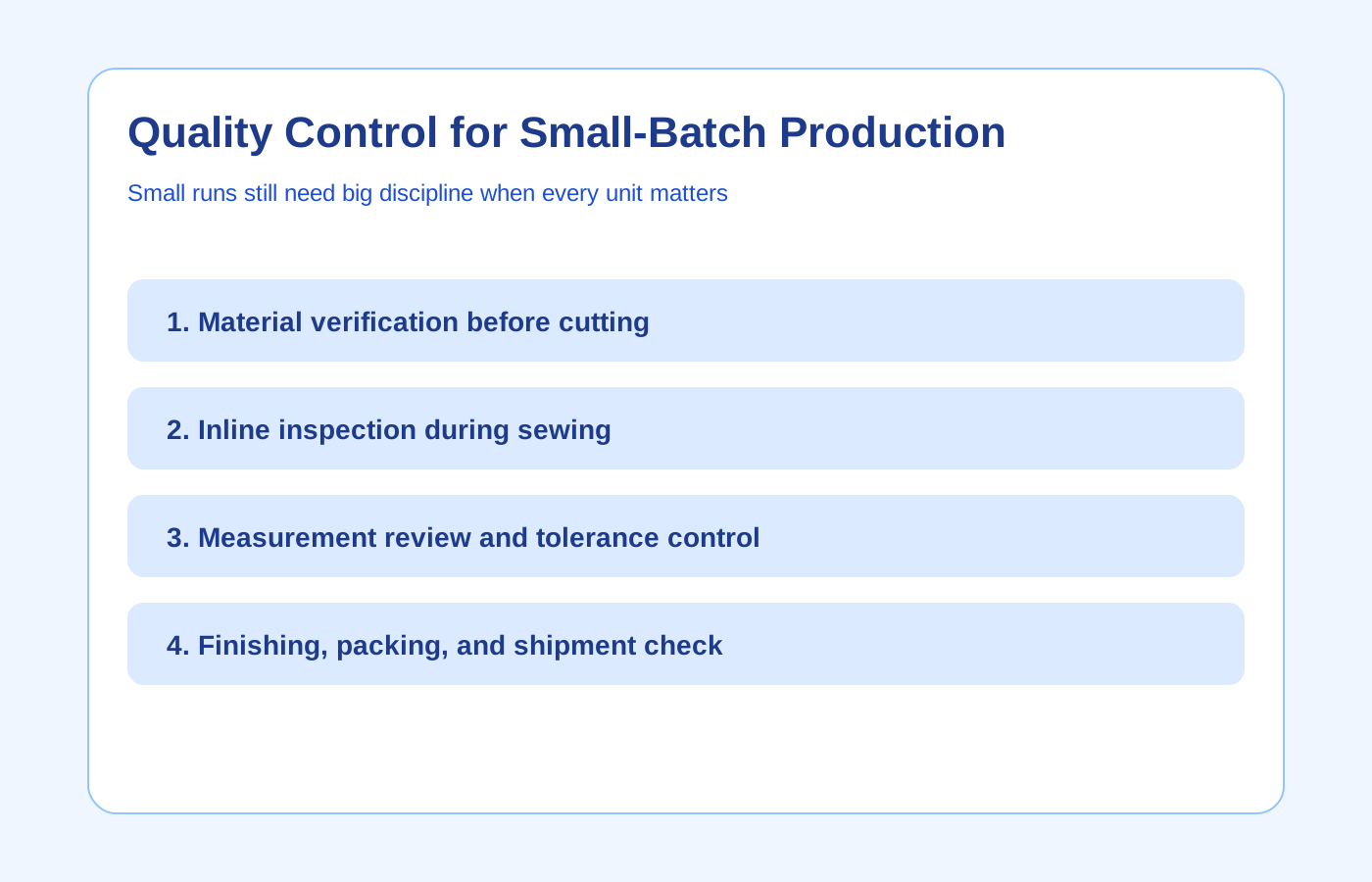
Some buyers assume quality control is mainly a concern for large orders, but that is backwards. In small-batch production, each defect carries more weight because there are fewer units to spread the loss across. A strong manufacturer should explain where quality is checked, who signs off, what tolerances are used, and how issues are documented before shipping. Buyers should ask for QC photos, measurement sheets, and examples of how the supplier handles rework.
Quality control is not just about catching mistakes at the end. It should begin with incoming material review and continue through inline inspection, finishing, and packing. If the supplier cannot describe these steps clearly, the risk of inconsistency rises. For new or growing brands, this can create customer complaints, refund pressure, and damaged trust.
| QC stage | Purpose | Buyer question |
|---|---|---|
| Material check | Confirms approved inputs are used | “How do you verify fabrics and trims before production?” |
| Inline inspection | Catches issues early during sewing | “Do you inspect during production or only at the end?” |
| Measurement review | Protects fit consistency | “How do you control size tolerances?” |
| Finishing inspection | Improves final appearance | “What do you check before pressing and packing?” |
| Packing review | Prevents shipment mistakes | “How do you confirm labels, quantities, and packaging?” |
For small-batch orders, disciplined QC is not a luxury. It is part of making the economics of the order work.
If price becomes the only comparison point, buyers often choose the quote that looks best and performs worst.
Buyers should compare manufacturers using a broader scorecard that includes category fit, sample performance, communication, QC process, lead-time credibility, and long-term partnership value.
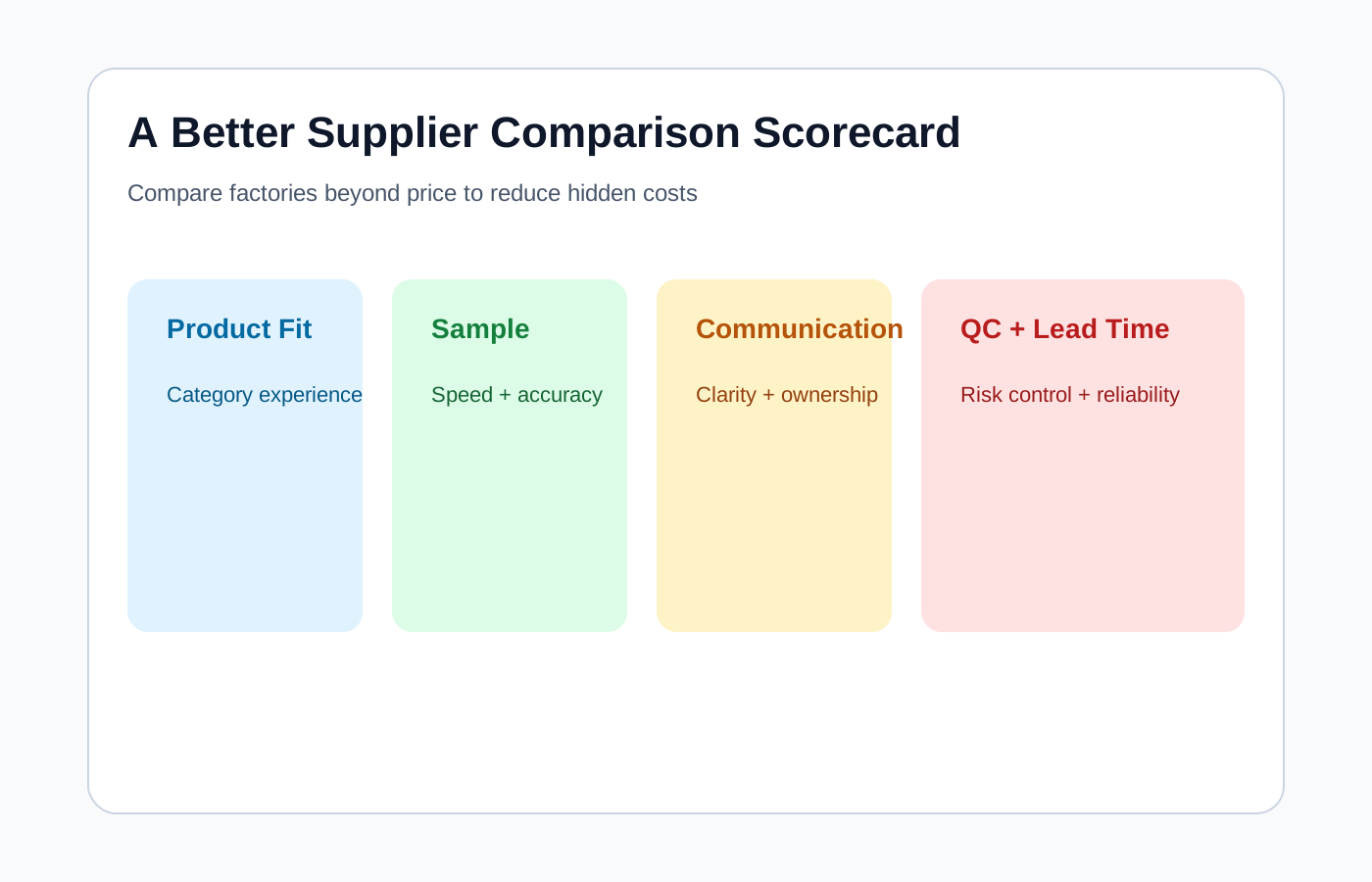
Price is easy to compare, which is why buyers often overuse it. But a supplier with a slightly higher quote may still be the better choice if they reduce rework, shorten revision cycles, and communicate clearly enough to prevent costly mistakes. For small-batch orders, that difference matters a lot because margins are already tighter. A cheaper factory that misses deadlines, confuses requirements, or produces unstable quality can quickly become more expensive than the original quote suggests.
A practical approach is to score suppliers across multiple dimensions instead of relying on intuition. That makes trade-offs more visible and helps buyers avoid being overly influenced by headline pricing.
| Evaluation area | What to compare | Why it matters |
|---|---|---|
| Product fit | Similar case experience and category knowledge | Reduces technical mismatch |
| Sample execution | Quality, speed, and revision accuracy | Predicts future production behavior |
| Communication | Clarity, responsiveness, and ownership | Supports smoother execution |
| QC system | Depth and discipline of inspection | Protects brand reputation |
| Lead time | Realistic planning, not just fast promises | Improves launch reliability |
| Commercial fit | MOQ flexibility and growth potential | Supports scaling over time |
The goal is not to ignore price, but to place it in the right context. Reliable manufacturers win by lowering hidden operational costs, not just by quoting lower numbers.
The best small-batch manufacturer is not the cheapest one, but the one that combines flexibility, quality discipline, and clear execution from sampling to shipment.



