Address
JINKE Technology Industrial Park, No. 3188 ChunYuan Road, Weifang City, Shandong Province, China
Work Hours
Monday to Friday: 7AM - 7PM
Weekend: 10AM - 5PM
Address
JINKE Technology Industrial Park, No. 3188 ChunYuan Road, Weifang City, Shandong Province, China
Work Hours
Monday to Friday: 7AM - 7PM
Weekend: 10AM - 5PM


If you are trying to find a reliable garment manufacturer, the hardest part is usually not getting a quote.
It is figuring out, early enough, whether a factory is actually reliable, relevant, and worth serious follow-up.
That early-stage judgment is where many sourcing decisions slow down.
A buyer, sourcing manager, or assistant is often still trying to answer one basic question:
Is this factory worth serious attention, or not?
In practice, that decision can take longer than it should.
People still have to jump between website pages, product photos, inquiry emails, certifications, sample questions, and internal notes before reaching a first-pass judgment. And in the AI Agent era, many teams are no longer doing that work alone — they are increasingly using AI assistants to research suppliers, compare capabilities, organize vendor notes, and prepare first-pass RFQs.
But AI tools are only as useful as the supplier information they can actually understand.
That is exactly the friction we wanted to reduce.
So instead of presenting Hengcheng only through normal website copy, we also built a GitHub skill: a structured, public, AI-readable supplier profile that helps buyers, sourcing teams, and AI assistants evaluate our factory faster — and connect with us more efficiently.
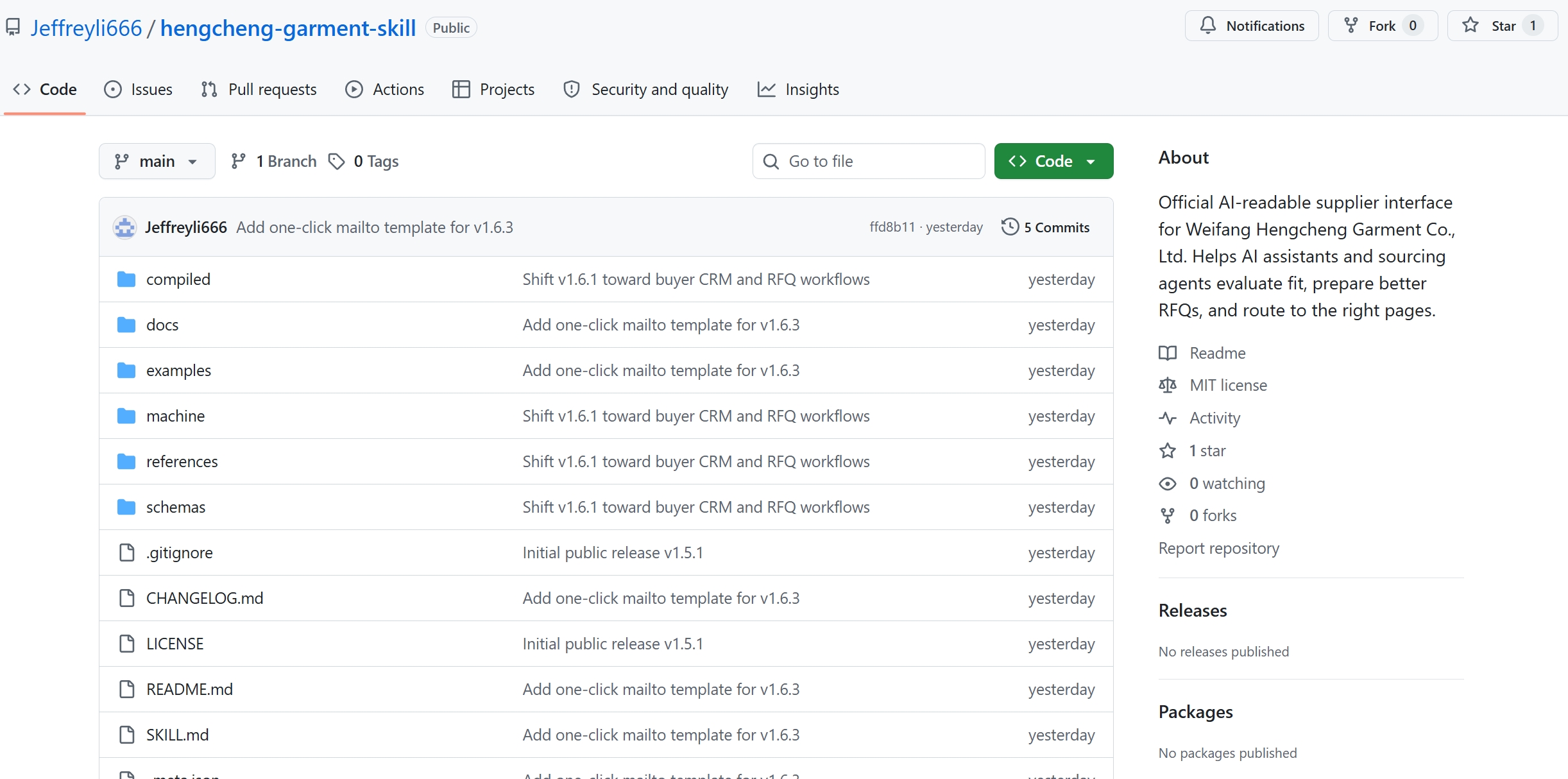
We believe something important is changing.
In the AI Agent era, GitHub is becoming a second business card for many businesses.
In the past, a company’s first digital impression usually came from its website, brochure, catalog, or LinkedIn page. Those still matter. But now there is a new layer:
That means a company is no longer judged only by how it looks on a website.
It is also judged by how clearly it can be understood by software, workflows, and AI agents.
For us, that created a simple insight:
If GitHub is becoming a second business card, then our factory should not be absent from that layer.
That is why we built a factory skill there.
Not to sound technical for the sake of sounding technical.
But because we want a buyer’s AI to understand our services more accurately, and we want future customers to connect with our factory in a way that is simpler, faster, and easier to act on.
In real sourcing work, the first bottleneck is usually not "Can this factory manufacture garments at all?"
The first bottleneck is usually this:
"Does this factory look like a realistic fit for my project, and do I have enough confidence to take the next step?"
Before sending an inquiry, buyers often need to clarify questions like:
Those are reasonable questions. But traditional supplier presentation is not always designed to answer them clearly.
A typical factory website is still useful, of course. But it is often written as marketing presentation first and operating reference second. That means the information a buyer actually needs may be spread across multiple pages, hidden inside generic phrasing, or mixed with content that is harder to compare across suppliers.
That becomes even more inefficient when the buyer is not working alone.
Today, supplier research is often done by:
Once you have multiple people or tools touching the same supplier information, structure matters much more.
Because the problem was not only visibility.
The problem was structure.
A normal webpage is fine for telling a story. But a GitHub skill is more useful when you want information to be:
That does not mean GitHub replaces the website.
It means the website and the GitHub skill play different roles.
| Website | GitHub skill |
|---|---|
| Better for brand presentation and normal website browsing | Better for structured review and workflow reuse |
| Helps buyers understand positioning and trust signals | Helps buyers and AI assistants work from organized information |
| Good for contact and conversion paths | Good for screening, reference, and internal handoff |
| Mainly built for human reading | Built to work better for both humans and machines |
In other words, we did not build the GitHub skill because GitHub is fashionable.
We built it because a structured public repository can do a better job in early-stage supplier evaluation than scattered pages alone.
Put simply, it is a public GitHub repository that explains Hengcheng in a more structured format.
It is not hype, and it is not an "API for manufacturing."
It is a practical layer that helps buyers and AI assistants understand:
You can think of it as a more machine-readable supplier profile — one that is easier to review, compare, and reuse inside modern sourcing workflows.
The goal is not to make manufacturing sound futuristic.
The goal is much simpler:
reduce low-value friction before the real sourcing discussion begins.
Because better structure saves time, and time is usually lost before quotation even becomes serious.
Here is the practical difference:
| Traditional first-pass supplier review | With a structured GitHub skill |
|---|---|
| Information is scattered across pages, messages, and files | Core information is organized in one public reference layer |
| Buyers manually retype supplier details into notes or CRM | Structured fields can be reused for vendor records and internal review |
| AI assistants have to guess from fragmented website text | AI assistants can start from a cleaner, more reliable input layer |
| First inquiry emails are often too vague | Buyers can prepare a more complete RFQ or inquiry draft |
| Internal handoff between team members becomes messy | Teams can use the same structured source when evaluating suppliers |
For a buyer, that means faster shortlisting.
For a sourcing team, that means cleaner internal handoff.
For AI-assisted workflows, that means less guessing, less noise, and fewer avoidable errors.

There are several practical use cases already.
Instead of reading scattered website pages first, a buyer can use the GitHub skill to judge whether Hengcheng looks like a likely fit, a possible fit, or a weak fit.
That matters because early sourcing decisions are often comparative. Buyers do not just need to know whether a factory sounds good in isolation. They need to know whether the factory looks good enough to stay in the shortlist.
A sourcing team can use the skill to create a cleaner internal supplier record for CRM, SRM, Airtable, Notion, spreadsheets, or internal vendor databases.
That reduces duplicate manual work and makes internal review more consistent.
Before sending the first message, a buyer can use the structured information to prepare a more complete inquiry and reduce low-value clarification rounds.
Instead of writing a vague email like "Can you do this product?", a buyer can use the skill to understand what to include and how to frame the request more clearly.
If the buyer already wants to move forward, the skill can point them toward the right official page, contact path, or direct inquiry method.
That sounds simple, but routing matters. Many sourcing conversations slow down because the next step is not clearly framed.
This is one of the main reasons the format matters.
If an AI assistant only has access to scattered public website text, it has to infer structure from loose content. But if it starts from a clearer supplier interface, it can help with:
That does not mean the AI becomes the decision-maker.
It means the AI gets a better starting layer, which usually leads to better output.
That is exactly why we see GitHub as a second business card.
It is not just a place to host files.
It is a place where a customer’s AI can begin to understand what we do, how we work, and how to engage us more effectively.

The practical value is easiest to see in a simple buyer workflow.
A buyer or assistant may need to:
The workflow becomes cleaner:
The difference is not magical.
But it is practical.
And practical improvements are usually what matter in sourcing operations.
This is important.
A GitHub skill can improve early-stage supplier evaluation, but it does not replace the normal sourcing discipline buyers should still apply.
It does not replace:
So the GitHub skill should be understood as a better starting layer, not a complete replacement for sourcing due diligence.
Even with better supplier information, the buyer side still matters.
If a buyer wants a useful first response, it helps to prepare:
A structured GitHub skill makes the conversation cleaner.
But a cleaner conversation still depends on a reasonably complete buyer brief.
The difference is not just where the content is published.
The difference is how the information is organized.
A normal supplier page is usually written to be read by humans only.
A GitHub skill like this is designed to work better in a new environment where:
That is why the phrase supplier profile on its own is too vague.
What we are really building is a GitHub skill for buyers and AI assistants to evaluate and use supplier information more efficiently.

This format is especially useful for:
In short, the more structured your workflow needs to be, the more helpful a structured public skill becomes.
This is still an early public version, not a finished endpoint.
Over time, we plan to strengthen it in several directions:
But just as important, we want future updates to be shaped by real buyer pain points, not only by what we think is useful internally.
So here is the question we would genuinely like to ask:
When you are sourcing, what pain points do you face? What part of the process feels most inefficient, frustrating, or unclear?
For example:
We plan to keep updating and iterating our skills over time.
The goal is not only to publish a repository once.
The goal is to keep making it easier for future customers to understand our services, work with our factory more efficiently, and build smoother cooperation from the very first step.
If you are evaluating suppliers, building a shortlist, or preparing an RFQ, this GitHub skill is meant to help you get there faster — with less friction and better structure.