Address
JINKE Technology Industrial Park, No. 3188 ChunYuan Road, Weifang City, Shandong Province, China
Work Hours
Monday to Friday: 7AM - 7PM
Weekend: 10AM - 5PM
Address
JINKE Technology Industrial Park, No. 3188 ChunYuan Road, Weifang City, Shandong Province, China
Work Hours
Monday to Friday: 7AM - 7PM
Weekend: 10AM - 5PM

A practical buyer guide for overseas apparel brands comparing China T-shirt manufacturers for OEM, private-label sampling, decoration, QC and bulk production.
Choosing a T-shirt manufacturer in China looks simple until you start comparing real suppliers. Many factories can sew a basic tee. Fewer can help you move from a product idea to an approved sample, then into bulk production with stable fabric, decoration, measurements, labels, packing and quality control.
If you are building an OEM or private-label T-shirt program, the question is not only “Who can make this cheapest?” The more useful question is: “Which supplier understands this product well enough to reduce risk before I place the order?”
The short answer: choose a T-shirt manufacturer that has relevant knitwear experience, asks specific questions before quoting, can explain its sampling process, and can connect fabric, decoration, measurement, packing and quality control into one workable production plan.
This guide is for overseas brands, retailers and sourcing teams comparing China T-shirt manufacturers for OEM or private-label work. It is not a promise that one supplier model suits every project. A basic promotional tee, an oversized streetwear tee, a fitted rib top, a polo and a heavily decorated graphic style require different production conversations.
Start by deciding what you are actually buying. Many buyers compare suppliers before they have defined the product well enough to compare quotes fairly. That creates false certainty: one factory may price a lightweight jersey tee, while another assumes heavier cotton, a different print method or simpler packing.
Before you ask for a serious quotation, write down the decisions that control the product.
A supplier can help you refine an incomplete brief. It cannot responsibly give a production-ready answer when the product itself is still undefined.
Product fit comes before supplier size, marketing claims or first price. A factory can be competent and still be the wrong fit for your specific program. For example, a supplier that is comfortable with basic uniforms may not be the best development partner for washed oversized graphic tees with large-format decoration. Equally, a fashion-focused factory may not be the most efficient choice for a simple high-volume promotional program.
Look for evidence that the production team understands the category you are developing.
| What to evaluate | What a useful answer looks like | Why it matters |
|---|---|---|
| Category experience | Can discuss similar T-shirts, polos, casual knit tops or comparable details without vague promises. | Relevant experience reduces avoidable sampling mistakes. |
| Fabric understanding | Can explain jersey, rib, pique, interlock, stretch, GSM and finishing tradeoffs. | Fabric controls hand feel, cost, shrinkage, drape and print performance. |
| Decoration review | Asks about artwork file, size, placement, colors and intended print/embroidery/wash effect. | Decoration is often where a reference image and a bulk result diverge. |
| Pattern and fit review | Requests a size chart, base size, fit reference or measurable comments. | Fit cannot be controlled from mood images alone. |
| Private-label handling | Separates garment, care label, neck label, hangtag, polybag and carton instructions. | Branding and packing are part of the production specification, not an afterthought. |
A good first conversation is not always the one with the fastest quote. It is often the one where the factory narrows ambiguity before it becomes a sample or bulk problem.
A useful supplier asks better questions. If you send a reference image and immediately receive a fixed unit price without questions about fabric, sizing, artwork, labels, packing or quantity, treat that number as a rough indication rather than a final production quotation.
These questions are practical signs that a supplier is trying to understand the work.
| Supplier question | Why the buyer should care |
|---|---|
| What fabric composition, GSM and hand feel are you targeting? | Fabric is one of the largest cost and quality variables. |
| Do you have a size chart, base measurements or a fit reference? | Measurements affect pattern work, fabric consumption and sample approval. |
| Is the artwork screen print, DTG, DTF, embroidery, rhinestone or another process? | Decoration route changes cost, artwork preparation, sample risk and bulk control. |
| What labels, hangtags and individual packing are required? | Private-label components need sourcing, approval and packing coordination. |
| What is the quantity by style, color and size? | MOQ, fabric allocation, pricing and production arrangement depend on the breakdown. |
| What needs to be approved before bulk production? | This shows whether the supplier has a real handoff from development into production. |
Questions alone do not prove capability. But a factory that can explain why a question matters is usually safer than one that says yes to everything.
There is no universal answer. A trading company can be helpful when you need a wide range of unrelated products, want one coordination point, or are still exploring suppliers. Direct factory communication is often stronger when the product needs close alignment on fabric, fit, decoration, labels and quality control.
| Buyer situation | Often the better fit | Reason |
|---|---|---|
| You have a defined T-shirt program and need sample development | Direct factory | Technical questions can move more directly between buyer and production side. |
| You need many unrelated categories in one buying trip | Trading company or sourcing partner | Broader supplier coordination may be more useful than category depth. |
| You care about fabric, print, fit, labels and QC details | Direct factory | There is less room for detail loss between the buyer and production workflow. |
| You are only validating a market or exploring product directions | Either | The immediate goal is discovery rather than production control. |
The key is transparency. Ask who will review the tech pack, who manages the sample, who confirms bulk details, and how comments move from the buyer to the production floor.
A quotation is only as useful as its assumptions. The cheapest line item can be misleading if suppliers have priced different fabrics, decoration methods, labels, packing standards or quantities.
Use one shared brief when comparing several factories. Then ask each supplier to state what is included, what is assumed and what could change after sample review.
| Quotation item | What to compare | Common source of confusion |
|---|---|---|
| Fabric | Composition, construction, GSM direction, finish and color requirement | Two “100% cotton” tees can have very different weight, hand feel and cost. |
| Garment construction | Neck rib, seam detail, sleeve/hem treatment and pattern complexity | Reference images may hide important construction differences. |
| Decoration | Method, artwork size, placement, color count and expected effect | A screenshot does not define production-ready artwork. |
| Private-label trims | Neck label, care label, hangtag, barcode sticker, polybag and carton mark | Small components can add cost and lead-time dependencies. |
| Quantity | Quantity by style, color and size | Total quantity can look sufficient while each color is too small for the same cost basis. |
| Quality and testing expectations | Measurement tolerance, workmanship standard and market-specific testing needs | “Good quality” is too vague to use as a production standard. |
Practical rule: do not ask “Why is one quote higher?” until you have checked whether both factories priced the same product. A transparent higher quote may be more useful than a low quote that leaves important items outside the calculation.
MOQ is not one fixed number that applies to every T-shirt. Production arrangement depends on style complexity, fabric availability, color count, decoration route, private-label components and the quantity split across sizes. This is why a responsible supplier should discuss MOQ and pricing after it understands the product, rather than publishing one universal promise.
Buyers should separate three different questions.
Instead of asking only for the lowest MOQ, ask the supplier to explain which parts of your program become difficult at the proposed quantity. That gives you a clearer basis for adjusting colors, fabrics, packaging or launch quantities.
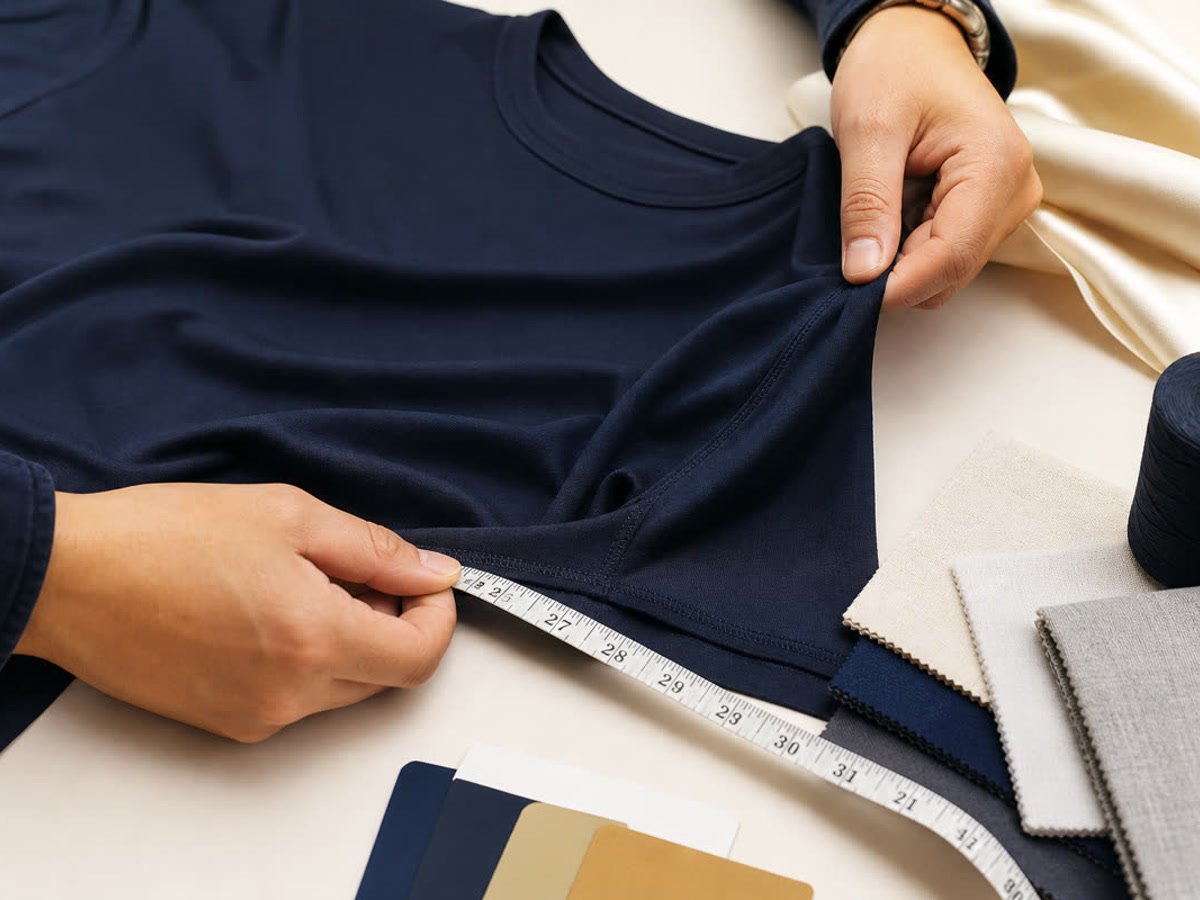
A sample is the point where a concept becomes a physical product. It is where hidden problems show up: fabric may feel too light, rib recovery may be weak, the neckline may sit differently, a print may look too large, or the intended oversized fit may become too long after grading.
For that reason, do not approve a sample only because it looks good in one photo. Review it against a short, written approval standard.
| Sample checkpoint | What to verify | Why it matters before bulk |
|---|---|---|
| Fabric and hand feel | Composition direction, weight, softness, stretch and recovery | Fabric changes the product more than most buyers expect. |
| Fit and measurements | Body length, chest, shoulder, sleeve, neck opening and grading intent | Fit corrections become more expensive after bulk cutting starts. |
| Decoration | Artwork accuracy, print hand feel, placement, color and wash appearance | Decorations need an approved reference, not a verbal description. |
| Branding and packing | Labels, hangtags, folds, polybags and carton marks | Private-label components are easy to overlook until shipment preparation. |
| Written comments | One consolidated comment list with clear approval/change points | Scattered chat feedback is hard to control in bulk production. |
For a deeper preparation checklist, see Hengcheng’s OEM T-shirt Sampling and Quotation Guide.
The risk does not end when a sample is approved. A serious supplier should turn the approval into a production reference that can guide fabric ordering, cutting, sewing, decoration, packing and inspection.
Buyers do not need to micromanage every factory step. They do need clarity on the evidence that carries the approved product into bulk production.
This does not require a supplier to promise perfection. It requires both sides to make the quality reference visible before quantity makes changes difficult.
Most supplier problems show early. Buyers often ignore the signs because the first price looks attractive or the sales response is fast.
A factory can give a rough estimate from a reference image, but a serious OEM quotation needs a usable brief. The brief does not have to be a perfect technical pack on day one. It does need enough information to separate a rough estimate from an actionable production proposal.
| Information | Minimum useful detail | Useful if available |
|---|---|---|
| Style reference | Front/back images, sketch or product photo | Physical reference sample and detail close-ups |
| Fabric direction | Composition, GSM range, hand feel or comparable product | Swatch, color standard and test expectations |
| Fit | Size chart, base measurements or fit notes | Grading rules and model/reference fit photos |
| Decoration | Artwork file, size, placement and intended method | Vector file, Pantone colors and approved effect sample |
| Branding | Neck label, care label, hangtag and packaging needs | Artwork, material, fold and carton instructions |
| Quantity | Estimated quantity by style, color and size | Reorder plan or phased launch expectation |
| Timeline | Sample deadline and desired bulk shipping window | Target launch date and approval milestones |
If fabric selection is still open, use a practical target rather than guessing. Hengcheng’s Custom T-Shirt Fabric Guide can help you describe jersey, rib, pique and interlock directions more clearly before the first factory conversation.
Do not compare only unit price. Compare the full risk profile using the same brief, the same requested quantity and the same approval criteria. A supplier with a slightly higher quote may still cost less in practice if it reduces sampling rounds, avoids fabric mistakes and communicates production risks early.
| Comparison area | Question to ask | What a buyer should record |
|---|---|---|
| Product fit | Have they made a genuinely comparable knit style? | Relevant examples and limits stated by the supplier. |
| Quote clarity | What is included, assumed and excluded? | Fabric, decoration, labels, packing and quantity basis. |
| Sample quality | Did the first sample match the target direction? | Fabric, fit, workmanship and decoration score. |
| Communication | Do they turn feedback into clear actions? | Response quality, not only response speed. |
| Production control | How will sample approval carry into bulk? | Measurement, pre-production and QC reference points. |
| Commercial fit | Can they support your quantity and timeline honestly? | Project-specific constraints and change triggers. |
Simple scorecard: score each supplier from 1 to 5 across product fit, quote clarity, sample quality, communication, production control and commercial fit. The total does not replace judgment, but it stops the lowest price from dominating the decision without context.
A short factory call can save several rounds of vague email. The goal is not to interrogate the supplier. It is to test whether both sides can turn the product brief into a shared production plan.
You are not looking for perfect English or a perfect sales presentation. You are looking for clear ownership, practical questions and an honest explanation of risk.
A good T-shirt manufacturer understands fabric, fit, decoration, sampling, labels, packing and quality control. It asks specific questions before giving a serious quotation and can explain how sample approval turns into bulk production instructions.
No. The cheapest first quote can become expensive if the supplier has priced different fabric, artwork, size specifications, labels or quality expectations from the product you actually need.
No. A clear reference image, fabric direction, fit notes, artwork information, quantity estimate and packaging needs can be enough for a useful first review. A full tech pack reduces ambiguity further, especially for more complex programs.
Yes, a factory can help narrow fabric options when you can explain the target hand feel, fit, price position, decoration method and reference product. The final fabric should still be approved through sampling or swatch review.
Ask for the supplier’s general approach, but treat the final answer as project-dependent. Style complexity, fabric, color count, labels, decoration and quantity split can all affect the workable production arrangement.
Hengcheng supports OEM and private-label T-shirt development, including production-side review of fabric direction, sample development, decoration coordination, labels, packing and bulk quality follow-up. Feasibility, MOQ and production arrangement depend on the product details and order specification.
The right T-shirt manufacturer is not just a sewing supplier. It is the production partner that can help you turn product direction into a controlled sample and then into stable bulk production.
Start with product fit, not the lowest first number. Compare factories using the same brief. Treat sampling as a decision stage. Then make sure the approved sample, measurement, fabric, decoration and packing details have a clear path into bulk production.
If you are preparing a custom T-shirt program, visit Hengcheng’s T-shirt manufacturer in China page and use the quotation checklist there before sending your inquiry.